
How to Search Court Dockets in Tennessee
Look first at the paper in front of you. It names the Tennessee court you need. A citation may point to a city court or a General Sessions clerk. A summons, warrant, or order can show Circuit, Criminal, Chancery, Juvenile, or Probate Court. An appeal notice, though, sends you down a different search path than the original trial case. That first check matters. No single statewide trial docket ties Tennessee's court divisions and record systems together.
For an appeal, use the Public Case History (PCH). Pick the field that matches what you already know. For a trial case, find the county and court. Then contact the clerk or use that court's official portal if one exists. Search by the exact case number when you have it. A name search may still need a filing date or court division to narrow things down. Remember that a Case Search result can be an index rather than a full docket or case file.
- Read the Tennessee court and county on the ticket, summons, warrant, order, or appeal notice.
- If the matter is a Tennessee appeal, search PCH by case number, case style, party name, or business or organization name.
- For a Tennessee trial docket, use Counties to find the court-specific clerk and check that clerk's local search or request route.
- Compare the Tennessee case header, entries, next setting, and disposition. Ask for the underlying order if its terms matter.
- Confirm a current hearing date with the Tennessee court or clerk, and request a certified copy from the clerk holding the record.
An empty online result is a coverage gap, not proof that no Tennessee case exists.
The Tennessee Statewide Case Search
Tennessee runs one statewide public case-history search: the Public Case History (PCH), branded “Appellate Case Search.” Its coverage is the Tennessee Supreme Court. It also spans the Tennessee Court of Appeals and the Tennessee Court of Criminal Appeals. Searching is free. No public account is needed. The name oversells the reach, though. PCH does not search unappealed Circuit, Criminal, General Sessions, Chancery, Juvenile, Probate, or Municipal Court cases anywhere in the state.
A PCH hit can still lead you back to the trial file. Case detail may list the originating court, the trial judge, and the local trial case number. You may also see appellate milestones, parties, dated “Case History” entries, and links to appellate filings. Treat those fields as clues for your next request. They will not convert an appellate number into a county trial search. The linked papers leave out many lower-court pleadings and exhibits. For the bigger picture, Court System walks through how a trial case and an appeal pass through different clerks.
Per the annual report, PCH history covers appellate records filed after September 1, 2006. Linked coverage begins with filings after August 26, 2013. Those dates govern appeals only. Local trial records sit outside PCH entirely.
| PCH search field | What to enter | Coverage boundary |
|---|---|---|
| Tennessee Case Number | The appellate number shown on a Tennessee court notice | Identifies an appeal, not every Tennessee trial docket with a local number |
| Tennessee Case Style | The Tennessee appeal's caption or style | Search has no Tennessee county or trial-court selector |
| Tennessee Party Name | A party name as it appears in the appellate case | Does not search all unappealed Tennessee county cases |
| Tennessee Business/Organization | The named organization shown in the appeal | No visible Tennessee date-range field was documented |
Match the search field to the appeal at hand, then hand the clerk its trial court and case number. Wildcards, result caps, and refresh timing go unconfirmed.
Which Courts Keep Dockets
Tennessee trial courts split into general-jurisdiction and limited-jurisdiction tiers, topped by three appellate courts. Circuit Court is the main general-jurisdiction forum. Some districts, though, give felony trials to a separate Criminal Court. Chancery takes equity along with many domestic and probate matters. Every county has a General Sessions Court. It handles limited civil claims, initial felony proceedings, authorized misdemeanors, and often traffic. Juvenile and municipal courts keep their own Tennessee records. They run under their own rules.
Don't assume a clerk's title tells you everything. The Circuit Court Clerk usually keeps Circuit and General Sessions records. A Criminal Court Clerk may hold another docket. So may a Clerk and Master, Juvenile Clerk, Probate Clerk, or Municipal Clerk. The Tennessee court-structure chart and AOC directories help you place a court tier. The paper that opened the case remains the best first clue.
| Court level | Typical docket scope | Where to search |
|---|---|---|
| Tennessee General Sessions | Limited civil cases, initial felony proceedings, some misdemeanors and traffic | Local Sessions clerk or Circuit Clerk, often the same office |
| Tennessee Circuit Court | General civil matters, assigned felony trials, and lower-court appeals | Circuit Court Clerk for the originating court |
| Tennessee Criminal Court | Felony trials and assigned criminal appeals where established | Criminal Court Clerk or local Circuit Clerk |
| Tennessee Chancery or Probate | Equity, domestic, probate, trusts, guardianship, or related matters | Clerk and Master or locally assigned Probate Clerk |
| Tennessee Juvenile or Municipal | Juvenile matters, city ordinances, and local traffic | The separate juvenile or city court clerk |
| Tennessee Appellate Courts | Appeals, appellate filings, and case history | Appellate Clerk and PCH |
The Tennessee court structure diagram lays out the statewide hierarchy. It also shows the place of limited-jurisdiction courts. A hierarchy shows where a case may travel. It does not put every filing under one office or one search system.
Federal courts serving Tennessee sit in a separate system altogether. A matter filed there is searched through the PACER Case Locator. It finds federal cases rather than a Tennessee state-court docket. That national index is a different route. It leads to a different record keeper.
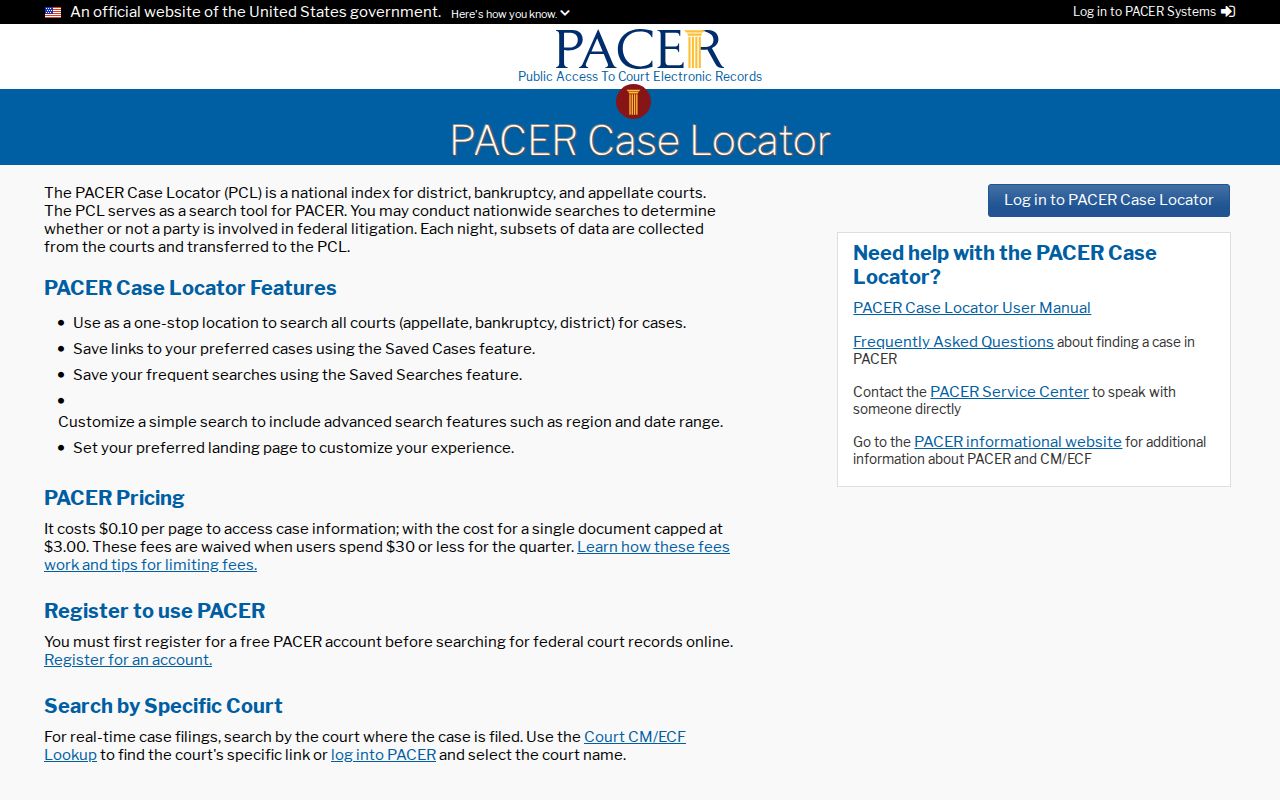
The federal locator is a separate search layer. A result there does not replace a Tennessee county clerk's register or PCH appellate history.
Tennessee Trial Docket Statistics
Filing statistics describe Tennessee court workload as a whole, never the status of one docket. The FY2023-24 report counted a 1.79 percent drop in trial filings. Dispositions fell 4.65 percent. Those numbers sketch the scale and movement of filings across the state. They cannot predict when a particular case gets a hearing, or how fast a clerk refreshes an online court docket index.
A 2026 Tennessee weighted-caseload study modeled resource deficits in 25 of 32 judicial districts. That model measures judicial workload. It is not a finding that every court has a backlog. It does not mean your case is delayed. Filings vary by court type. Statewide totals never replace checking a specific trial register or calendar. AOC statistics come from clerk-reported data. Annual reports show only statewide aggregates.
Tennessee Trial Docket Search Routes
No Tennessee-wide trial portal lets you search every county by name. Systems differ by court, division, record years, and document access. One clerk publishes an online index while another handles criminal filings by hand. Some offices offer portals. Others rely on calendars, terminals, or staff. AOC lists courts and clerks but holds no local trial file. The docket search itself happens at the county level.
Start with the clerk for the exact court. The Tennessee court clerk directory routes readers to local offices. A courthouse finder locates a court by place. Ask the clerk whether your case type and year appear online. Ask whether older files sit in archives. Ask whether the index holds document images. If the online record comes up short, call or visit. Ask about a terminal. You can also send a written request through the channel that office accepts. A Tennessee Public Records Act request goes to the government record coordinator when the record is administrative. It never makes AOC the keeper of a county case file.
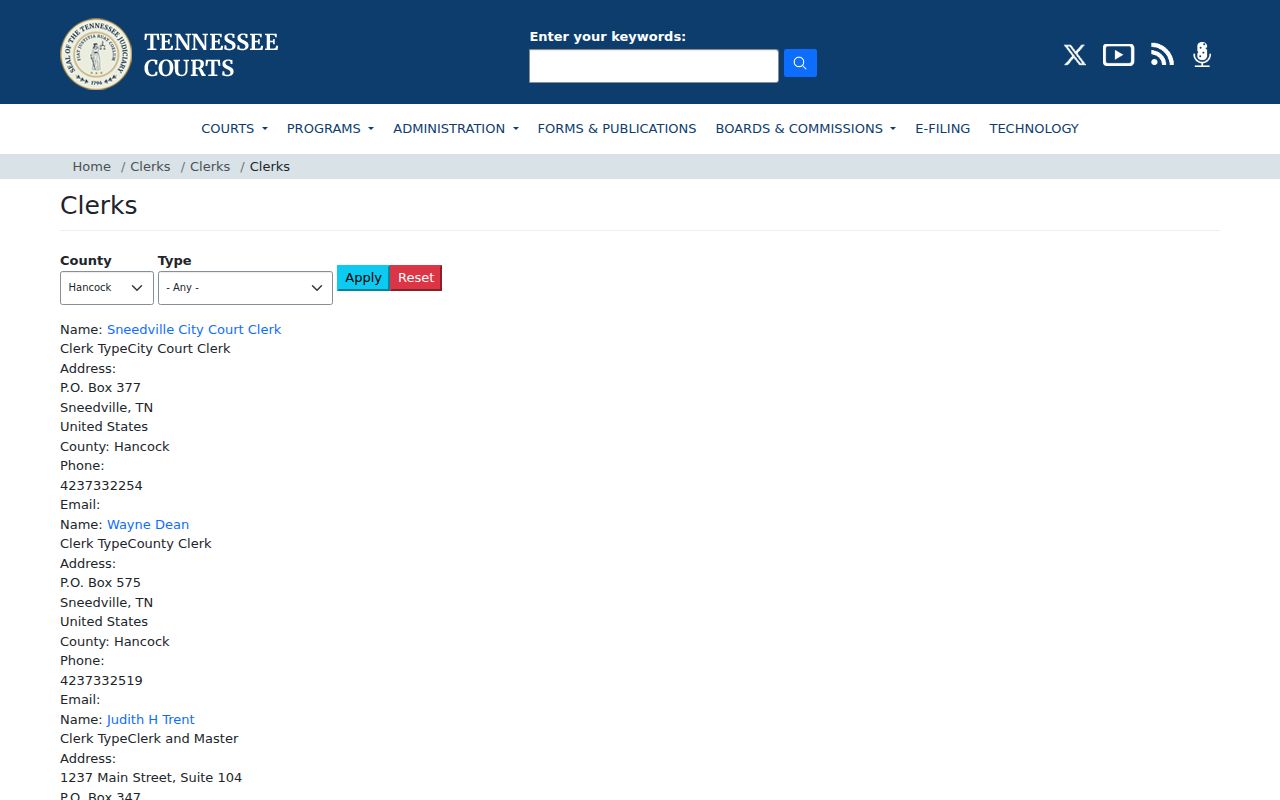
The Tennessee directory leads to local clerk offices. Each office must confirm its portals, hours, fees, and record coverage directly.
A Tennessee calendar can confirm a court date. It may leave out earlier entries or filed papers. A case index lists parties and status, but no document image appears there. Older dockets may live on paper or in archived systems. When nothing appears, check the court name, spelling, date range, and clerk assignment. Do not treat the absence as final yet.
Tennessee Court Dockets Through Trial Levels
Tennessee's 32 judicial districts organize trial courts across 95 counties. General Sessions operates in every county, but division counts and names are not uniform. A lower-court case can move to Circuit Court or Criminal Court for a new stage. The receiving court may assign a new case number and keep its own register. For a Tennessee civil matter, jurisdiction can turn on the kind of claim. The court's statutory role matters too. Ordinary General Sessions civil jurisdiction covers claims up to $25,000 under Tenn. Code Ann. §16-15-501(d)(1). Exceptions include detainer actions and recovery of personal property.
Appeal records form another layer. A notice of appeal enters the originating trial file first. Then a distinct appellate case opens with the Appellate Clerk. Tennessee PCH can trace the appeal's history and may link appellate papers. It does not pool trial events from the county. Following a matter from first appearance to appeal, a Tennessee reader may need several records. These include the local clerk's register, the receiving trial court's file, and the appellate case history together. The court hierarchy explains those transitions. It promises no single shared portal.
The Tennessee AOC courthouse directory lists court locations and clerk routes. When a record crosses court levels, keep both numbers and court names from the notices. An appellate case number is not a substitute for the trial number.
What a Court Docket Shows
A Tennessee court docket lists filings, actions, settings, and results, yet it is not the case file. A motion entry does not include the motion itself. A setting does not prove the hearing happened. A disposition may not spell out the signed judgment's full terms. Ask the clerk for the document when details matter.
| Tennessee case number | A local identifier set by the court or clerk. Tennessee does not have one universal public trial case-number format. |
|---|---|
| Tennessee parties and roles | The Tennessee case caption names parties as entered, such as plaintiff, defendant, petitioner, or respondent. |
| Tennessee filings and entries | A Tennessee case chronology may show a complaint, answer, motion, order, service return, or other event without exposing the paper. |
| Tennessee hearing setting | A future or past date may include a time, courtroom, judge, or setting type, depending on local display. |
| Tennessee court and judge | The court and judicial officer identify the file's location and who heard a listed event. |
| Tennessee disposition | A result or status label points to an outcome; the signed order or judgment supplies controlling terms. |
In Tennessee, an appeal, remand, transfer, or lower-court appeal may add another register. Compare the date and court on every entry in the Tennessee docket. A docket marked "disposed" is not necessarily the end. It can still hold a judgment, sentence, enforcement step, or later appeal. Get a certified copy from one place only. That is the clerk responsible for the Tennessee case file.
Tennessee Docket Terms and TJIS Labels
"Docket" and "docket number" are everyday words in Tennessee trial courts. The public-facing abbreviations depend on local choices. Each county's software and clerk practice sets them. The Administrative Office of the Courts (AOC) uses reporting categories to compile statewide statistics. Those categories help compare filings and dispositions in Tennessee annual reports. They do not require every public portal to display the same codes.
- Continuance or reset
- A matter was moved to another date. Check a newer docket entry or notice; the earlier setting may remain in an old calendar.
- Nolle prosequi
- Notice by the Tennessee prosecution that it will not pursue a charge. Read the entered record or order for the case's next status.
- Disposition
- An outcome or status entered in the Tennessee record. The label may not include the terms of a signed order or judgment.
- ALC, PCR, and PV
- AOC criminal reporting labels for appeal from lower court, post-conviction relief, and probation violation. They are not a universal portal glossary.
Tennessee AOC reporting leans on fixed labels. An indictment, presentment, transfer, diversion, acquittal, conviction, or dismissal each carries its own tag. Civil cases get sorted into claims like contract, tort, real estate, divorce, probate, and guardianship.
Treat these as statistical classifications only. They do not guarantee that a county's docket interface offers a matching filter. When a local abbreviation on a docket entry confuses you, ask the clerk for the event key or the filing it points to.
Public Access to Dockets
Tennessee treats court records as public by default. Statutes, court rules, and sealing orders draw the limits. Rule 34 of the Tennessee Supreme Court governs access to court records. The Tennessee Public Records Act (TPRA), Tenn. Code Ann. §§10-7-503 et seq., reaches wide ground. It covers a large share of state and local government records. Send a request for an administrative record to that record's public records coordinator. A case-file request goes to the clerk who holds the file.
Plenty of court information stays limited or redacted. Juvenile records carry special protections. Sealed filings may be withheld. Tennessee law governs how personal identifiers are handled. A blank search result proves little by itself. It cannot tell you whether a record is sealed. It may fall outside the portal's years, sit with another court, or simply never have been indexed. If access is denied, Tennessee readers can ask the custodian to name the rule or statute behind the refusal.
Key Tennessee access rules:
Tennessee Supreme Court Rule 34 sets access procedures and exceptions for court records.
Tennessee Code Ann. §10-7-503 provides a public-record request process, including a seven-business-day response step when a record is not promptly available; §37-1-153 limits access to juvenile court records, subject to statutory exceptions; and §20-6-104 addresses personal identifiers and redaction in court filings.
Tennessee Rule 20B covers public electronic access to appellate filings and took effect July 1, 2026. It creates no statewide trial-case search. A TPRA request still goes to the government custodian holding the record.
Tennessee Court Copy Fees and Public Records
Finding a Tennessee docket and getting a copy are two different tasks. Tennessee law sets base charges for some clerk copies. But the final total turns on the product, the pages, the delivery method, and local procedure. A copy-page fee is not a filing or transcript fee. It is also not the price of every online image.
Confirm the exact amount with the clerk. The statewide manual describes the core charges, while local offices state which payment methods they accept.
| Record product | Statewide base or rule | What to confirm locally |
|---|---|---|
| Plain paper copy | $0.50 per page under Tenn. Code Ann. §8-21-401(i)(4) | Page count, electronic-copy practice, postage, and payment |
| Tennessee certified paper copy | $5 certification or seal under §8-21-401(i)(5), plus page charges | Which Tennessee record can be certified and the total delivery cost |
| Official electronic recording duplicate | Rule 26 sets $50 if requested at the same time and $100 later | Whether the rule applies, who takes the request, and whether a transcript is separate |
| Transcript or online image | No single statewide rate was confirmed | Reporter estimate, local portal price, subscription, and archive charges |
These Tennessee figures attach to specific products. They do not mean every clerk charges one universal docket-search fee.
County copy policies differ. Portal vendors, certified delivery, and archived retrieval can all change the cost. A transcript comes through the court reporter or administrator rather than off the docket printer. The Tennessee clerk who keeps the case can point you to the office holding the original and tell you whether a record qualifies for public inspection or certification.
Tennessee Court Technology and Docket Access
Tennessee's appellate tracking and its local trial systems grew up on separate tracks. The Appellate Clerk adopted C-Track for online case tracking in 2013, and PCH now displays appellate histories. Trial courts across Tennessee still work with a mix of local case-management and e-filing tools. Paper workflows and court-specific portals remain in the mix too. An e-filing vendor may receive a filing. That does not open a free public register or image to everyone who runs a docket search.
The legislature pushed for more. Tennessee Public Chapter 947, codified at Tenn. Code Ann. §16-3-822, directed the AOC to develop a statewide court information-systems solution. The February 2026 status report described procurement and a December 2025 award. But it set no public trial search launch date and no county migration schedule. The Tennessee General Assembly archive lists a fourth report dated September 2, 2026. That listing by itself does not establish a vendor, a public go-live date, or a migration plan.
The practical route stays simple. Use PCH for state appeals. Use the local court and clerk for trial dockets. Federal cases run on a separate federal system. AOC reporting tools standardize selected statistics, not public case-level access. Check the AOC technology project updates for verified status. Then rely on the court's local page for any Tennessee record you need to act on today.
Find Court Dockets by County in Tennessee
The court clerk who maintains a case holds the full Tennessee trial docket. So the county route matters whenever an appellate search does not apply or a local result needs confirmation. Start with the county name printed on a ticket, summons, order, or judgment. Metro areas often run several court levels and clerk offices at once. A smaller county may combine clerk roles. The cards below link to county sites. Each page can route you toward that locality's docket search, clerk, and court system.
The University of Tennessee County Technical Assistance Service directory lists every Tennessee county and its seat.
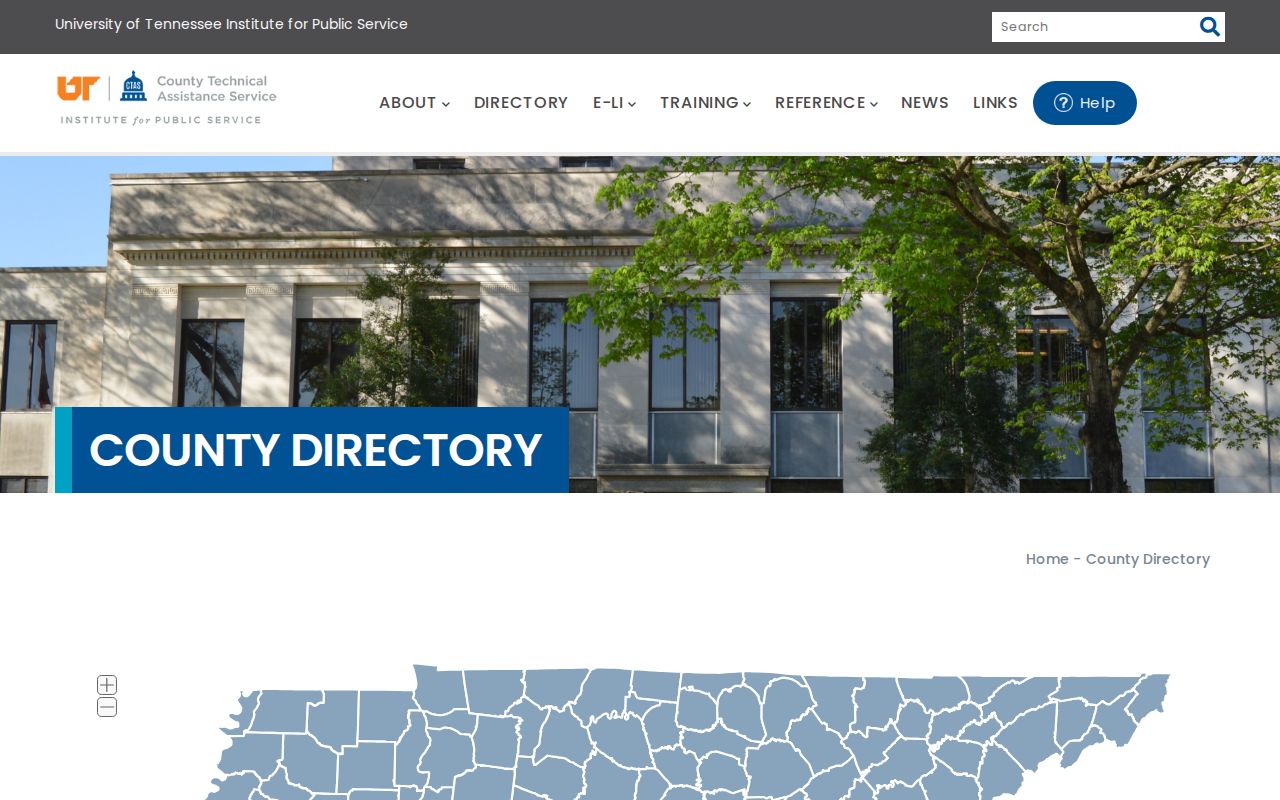
A county seat listing helps sort out courts and places with similar names. It cannot replace the court name printed on a case notice.
Davidson County
Nashville · Metro Nashville's largest mix of trial-court divisions and clerk routes.
Shelby County
Memphis · West Tennessee metro system with multiple court divisions and clerk paths.
Knox County
Knoxville · East Tennessee metro with separate civil and criminal clerk functions.
Hamilton County
Chattanooga · County court and calendar systems span several local divisions.
Rutherford County
Murfreesboro · Middle Tennessee court routes include local case search and appeals.
Williamson County
Franklin · Nashville-region county with distinct Chancery and Circuit routes.
Montgomery County
Clarksville · Clarksville-area records route by court division and local system.
Sullivan County
Blountville · Tri-Cities region with district and local-court boundaries.
Browse Counties to open the local site for the county named on your case paper.