
How to Search Tennessee Criminal Dockets
No single Tennessee search pulls every criminal trial docket. General Sessions, Circuit, a standalone Criminal Court, municipal courts, and Juvenile Court each handle different Tennessee case types. Some handle different stages. Begin with whichever court the citation, warrant, or notice names. Check whether that court runs its own portal. The Public Case History system covers appeals only. The trial docket and case file remain with the clerk for that court and division.
Before a Tennessee criminal case search, copy the name straight off the charging paper. Note the local case number, any citation number, and the filing or arrest date. Number formats differ by court, county, division, and year. Guessing a Tennessee pattern will mislead you. The Case Search guide walks through how a trial docket search differs from an appellate case history.
Every Tennessee criminal case carries a local trial docket and court record. An appellate lookup cannot stand in for that file. And remember that a docket entry may list a filing without the paper behind it.
- In Tennessee, read the citation, warrant, or notice and note the Tennessee court, division, county, and case number.
- Open the Tennessee court or clerk’s official Tennessee page and use its criminal search, if available; enter only offered fields.
- If no useful result appears online, use Counties to find the proper local court and clerk contact route.
- Ask the Tennessee clerk about a courthouse terminal, paper index, Tennessee archive, separate division, or a specific filed record.
- For a Tennessee criminal appeal, search the appellate Public Case History, then confirm trial entries with the originating clerk.
Tennessee Criminal Docket Search Fields
Tennessee does not hand every clerk the same search form. Davidson shows how local the choices can be. Its Criminal Court Clerk asks for a Search Type, First Name, and Last Name, with a Date of Birth field you can fill in or skip. Pick your search type from the drop-down. Names should match what appears in the arrest entry, and a matching result may list a charge or a citation along with its disposition. Treat these as Davidson's fields, not some standard Tennessee portal.
The depth of the docket index is local as well. Davidson covers General Sessions dispositions from January 11, 2000, state trial dispositions from July 11, 2000, and legacy records reaching back to 1980. For anything older, ask the clerk. Expunged charges and citations are left out entirely. Other Tennessee courts may split Sessions, Circuit, and Criminal Court into separate searches, or a division may have no public web index at all.
For a live Tennessee example, the official Davidson criminal search shows the field labels described above on the clerk's own page.
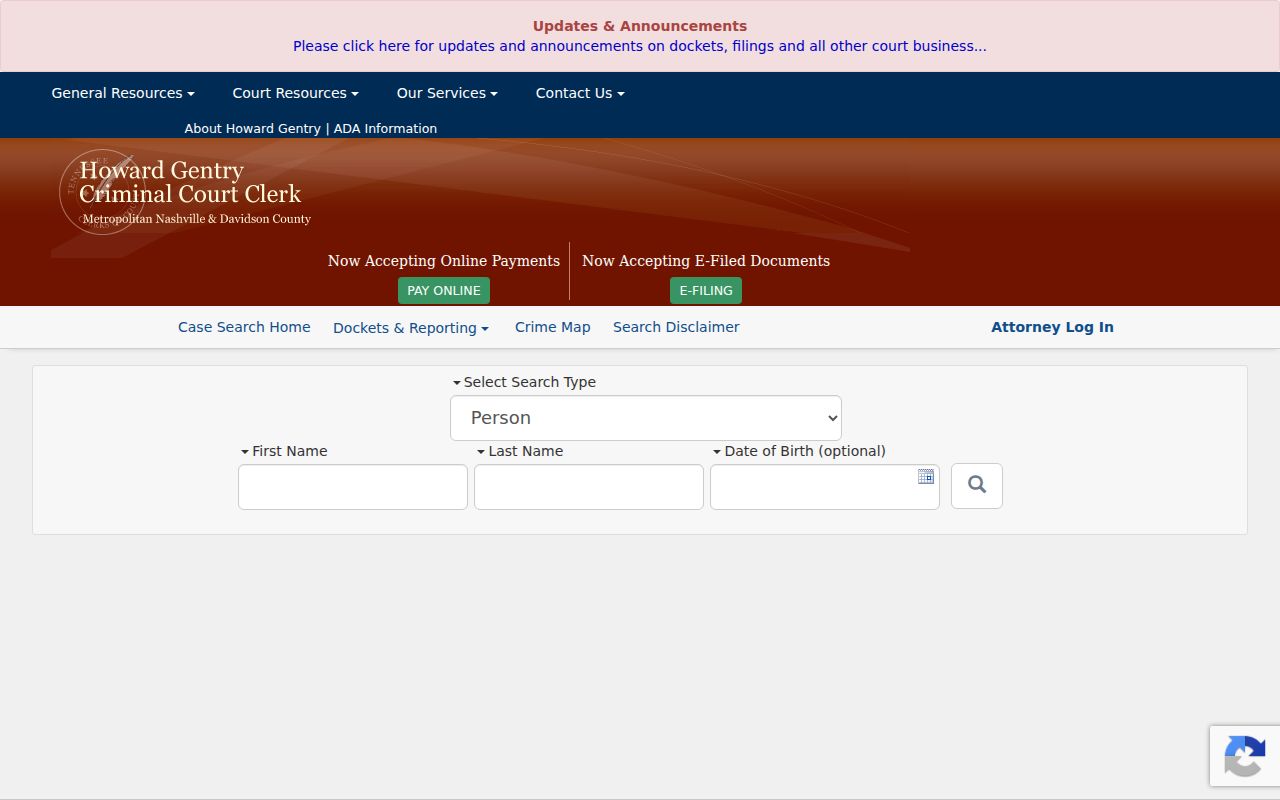
Note: This page points you to Davidson for orientation. Each Tennessee clerk builds the search fields its own portal can handle.
Note: In Tennessee, a missing online result can reflect the wrong court, an older file, an expungement, or a division the portal omits.
What a Criminal Docket Shows
A Tennessee criminal docket lists the filings, actions, and settings in one trial-court case. It is not the full court record or case file. Local search results vary from court to court, and AOC statistical forms play no part in setting docket search fields.
| Case number and court | The local identifier, court or division, and sometimes a case type; the syntax varies across Tennessee courts. |
|---|---|
| Charge or filing | A Tennessee charge, statute, citation, indictment, presentment, or information may be noted. The filed paper gives the full text. |
| Events and settings | Tennessee entries may list an appearance, motion, hearing, trial, or next date as filed or scheduled. |
| Plea and disposition | A Tennessee plea or result label may appear, but it does not replace the signed Tennessee judgment or sentence. |
| Bond and release | A Tennessee docket may note bond or a later event; the order states terms and changes. |
Reading a Tennessee criminal docket takes a bit of discipline. A charge line is not a finding of guilt. A future court date is only a setting, not a hearing that already happened. The docket itself is just an index of case events, so when the actual terms or a sentence matter, ask the clerk for the signed court record behind the entry.
Tennessee Criminal Docket: Charges and Bonds
Tennessee docket entries label different steps in a case, and the labels matter. A charge is only an allegation. A bond entry reflects a release decision, while a plea records the defendant's response. The disposition is the recorded result. The signed judgment and sentence carry the court's actual action. An arrest or a charge alone is never a conviction.
Where will you find bond details? They may sit in the General Sessions register. Or they may sit in a later Circuit or Criminal Court file, in an order, or in a jail record. Later Tennessee orders can change the terms or the release status. For a condition or a forfeiture, request the court order itself. A jail roster is no substitute.
The Tennessee AOC Criminal TJIS manual sorts filings and outcomes into statistical groups: appeals, post-conviction relief, expungement, probation violation, acquittal, conviction, dismissal, transfer, and diversion. Treat those as reporting categories, not codes the Tennessee portal requires.
Note: For a Tennessee case, if a portal shows a disposition without its terms, request the signed judgment or order from the holding clerk.
Stages on a Criminal Docket
How does a Tennessee criminal case unfold? It may start with a complaint, a citation, or an arrest. Then comes an initial appearance, bond, and a preliminary hearing or a waiver of that hearing. A felony can move up by bindover. Or it can proceed on an indictment, presentment, or information. Arraignment comes next, then motions, a plea or trial, judgment, sentence, and possibly an appeal. Other paths exist too: direct indictment, diversion, dismissal, and city ordinance cases each run differently.
Tennessee docket flow: Citation, complaint, or arrest › Initial appearance and bond › Preliminary hearing or waiver › Bindover or charging instrument › Arraignment and settings › Plea or trial › Judgment and sentence › Appeal
One Tennessee criminal matter can generate more than one trial-court docket. When a Sessions preliminary case moves to Circuit or Criminal Court, search the court records for both. An appeal adds yet another layer: a separate Tennessee appellate case with its own docket.
Tennessee Criminal Docket Timing
Timing rules shape what a Tennessee criminal docket can tell you. Rule 5 of the Tennessee Rules of Criminal Procedure requires an initial appearance without unnecessary delay. But it sets no uniform 24-hour deadline for county portals or docket updates. Instead, it governs the court process that follows an arrest.
Preliminary hearings work on clocks measured from that first appearance. Rule 5.1 allows 14 days when the person is in custody. It allows 30 days when released. A waiver, an exception, or a permitted extension can move the hearing. So a date on the docket proves little by itself. It does not show whether the hearing happened or whether an extension was proper. Later entries and orders tell that part of the story.
The official Tennessee criminal rules spell out the full process. When a date looks off, call the clerk or the court coordinator. Ask for the most recent notice. An old calendar line may have been superseded.
Note: Tennessee Rule deadlines describe court procedure; case posture and permitted exceptions affect the date shown in a particular file.
Which Court Holds Criminal Dockets
Tennessee criminal dockets split by stage, charge, and local court setup. General Sessions takes first appearances and preliminary work, and it can decide certain authorized misdemeanors. Felony trials belong to a separate Criminal Court where one exists. Otherwise the Circuit Court hears them. City ordinance cases go to municipal courts, and Juvenile Court files carry restricted access.
| Court or stage | What the docket may cover | Likely clerk route |
|---|---|---|
| General Sessions | Tennessee initial appearance, bond, preliminary hearing, or authorized misdemeanor matter | Sessions clerk or Circuit Court Clerk, depending on local arrangement |
| Circuit Court | Tennessee felony trial where there is no separate Criminal Court, plus assigned work | Circuit Court Clerk |
| Criminal Court | Tennessee felony trials and certain lower-court criminal appeals where established | Criminal Court Clerk or local Circuit clerk |
| Municipal or Juvenile Court | Tennessee city ordinance cases or restricted juvenile proceedings | The city or Juvenile Court clerk named on the paper |
Clerk responsibilities differ from county to county. A Circuit Court Clerk often runs the office for both Circuit and Sessions, though a separate Criminal Court clerk or another local office may keep its own criminal docket files. The Tennessee AOC clerk directory, paired with the county directory, points you to whichever office is named on the court paper.
Why PCH Misses Tennessee Criminal Dockets
The Tennessee Public Case History (PCH) tracks appeals only. It covers the Tennessee Supreme Court, the Court of Appeals, and the Court of Criminal Appeals. It is not a trial-level docket search. A local misdemeanor will not show up there. A pending Sessions matter will not either. Nor will a felony still sitting in Circuit or Criminal Court, just because it is a Tennessee case.
An appeal builds its own history, while the originating clerk keeps the trial docket. A trial court register might note an appeal or a remand. Yet the two files stay distinct. Search the trial court for the case itself. Use the official Public Case History for the appeal. An empty result there does not mean no Tennessee file exists.
Public Access and Sealed Criminal Dockets
In Tennessee, court records are open to the public by default. Laws, rules, and orders can still restrict a whole case or a single field. Rule 34 governs court records. The Public Records Act covers public records held by state and local custodians. A request for a Tennessee trial file goes to the clerk who holds it. No statewide office receives them.
Juvenile files are generally closed, aside from statutory exceptions. A sealed or expunged matter may be left out entirely or shown only in part. Personal identifiers may be redacted. One missing result proves nothing about a case's status. Ask the court directly what can be inspected and how.
Key Rules:
Tennessee Supreme Court Rule 34 sets access rules for court records, with exceptions created by law, rule, or order.
Tennessee Public Records Act, Tenn. Code Ann. § 10-7-503, provides a public-record request process; when a record is not promptly available, the custodian may produce it, deny in writing, or provide a reasonable estimate under the statute.
Tennessee Code Annotated § 37-1-153 limits inspection of juvenile court files, subject to the statute’s exceptions.
Tennessee Code Annotated § 20-6-104 requires redaction of certain personal identifiers in court filings.
Tennessee Criminal Docket Search Gaps
A Tennessee docket search coming back empty is rarely the end. Check the court named on the case paper before you run the same search again. The case may have moved from Sessions up to Circuit or Criminal Court. Or it may sit with a municipal or Juvenile clerk. Double-check spelling, the date range, and the case number. Then ask the clerk about archives, restrictions, or expungement.
Online access is only one channel in Tennessee. Ask the clerk about a public terminal, a paper calendar, and phone or counter help. Ask whether requests by mail or email are accepted, too. No statewide schedule or request form exists. Name the court, the date, and the paper you want. The AOC expungement guidance makes the point plainly. A missing result alone does not establish expungement.
Know which item you need, too. A docket printout, an order, a certified copy, and a transcript are different records. Copy charges and request methods vary by office. So tell the Tennessee clerk exactly which one you're after.
Note: In Tennessee, name the court, date range, and whether the request is for a docket printout, certified order, or transcript.