
How to Search Tennessee Civil Dockets
Trial-level civil dockets in Tennessee have no statewide search. A civil case can live in General Sessions, Circuit, Chancery, Probate, or municipal court. Clerk duties shift from county to county. So start where the warrant, complaint, or petition points. Each local portal picks its own civil case search fields and coverage. For appeals, the Public Case History site covers the Tennessee Supreme Court, Court of Appeals, and Court of Criminal Appeals. It does not reach civil trial dockets. The clerk holding the file keeps the Tennessee trial docket and case record.
Gather the party names exactly as written. Add the civil court, division, and any docket number. There is no single civil case-number pattern statewide. The format depends on court, county, and year. Search with the assigned Tennessee case number each time. The Case Search guide explains the statewide and county split in more depth.
- Read the Tennessee civil warrant, complaint, or petition for county, court, division, party names, and docket number.
- Open the official Tennessee court page and search its civil case index with the fields offered.
- If the court index does not cover the case, use Counties to find the docket clerk.
- Ask the Tennessee clerk about a courthouse terminal, paper docket, staff case search, or mail and email requests.
- Request the Tennessee court order, judgment, or certified record if the docket entry is not enough.
Tennessee Civil Docket Fields
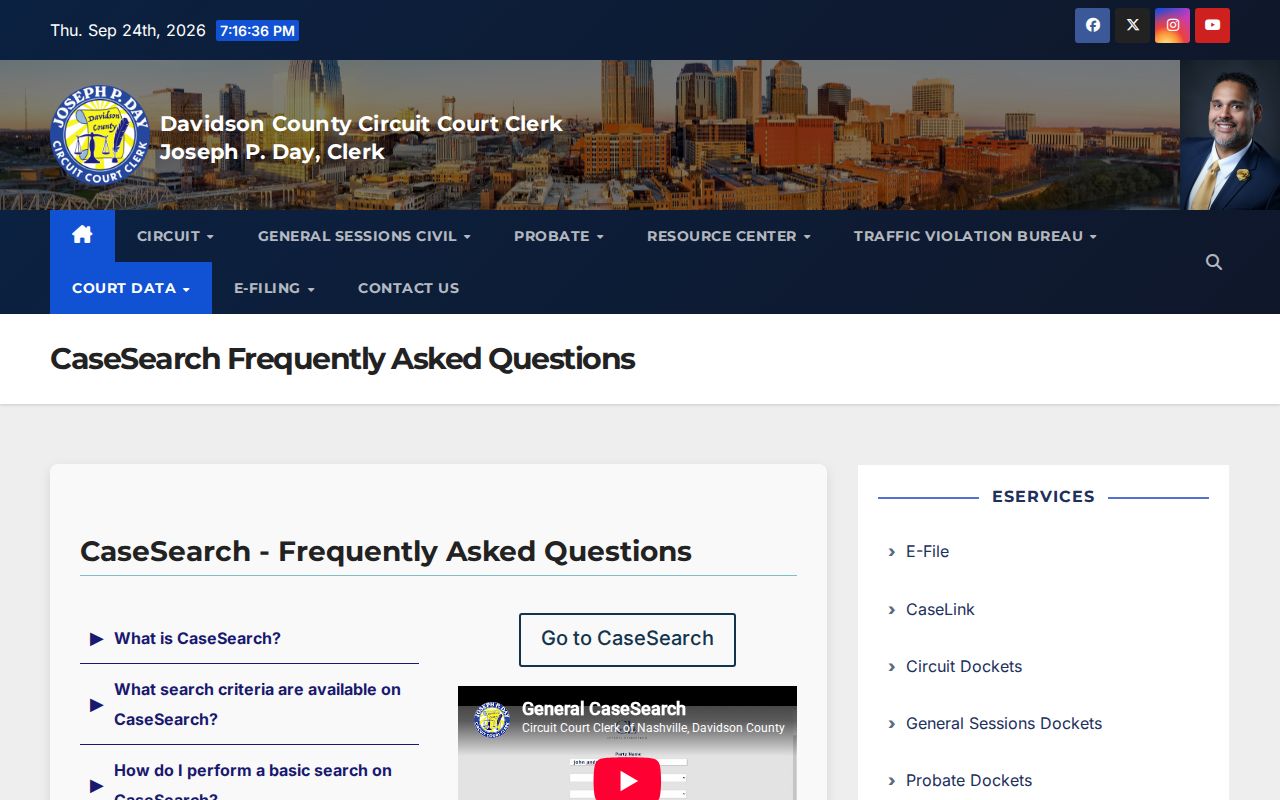
Davidson County's Circuit Clerk CaseSearch FAQ offers one Tennessee civil docket search example. It is not a statewide form. Its fields include Party Name; Party Type as All, Plaintiff/Petitioner, or Defendant/Respondent; Office as General Sessions, Circuit, or Probate; and File Date From and To. Nothing in the FAQ promises those fields are required. Nor does it promise other Tennessee courts use the same labels.
The free Davidson County, Tennessee, index lists civil case entries without document images. CaseLink's separate FAQ describes a paid service for civil case details and court record images under its own access terms. Every other Tennessee clerk builds its own search and copy routes. So a Davidson form cannot reach the rest of the state's dockets.
The official Davidson County, Tennessee CaseSearch page displays the party and date filters the clerk offers.
Other counties: For any other Tennessee court, follow that clerk's instructions and ask which divisions and dates its index covers.
Note: The Davidson field list is a Tennessee local example and should not be treated as a statewide civil-search schema.
What a Civil Docket Shows
A Tennessee civil docket gathers the filings, actions, and settings in a case. Coverage varies by portal and court. Use the full local case number as assigned; guessing a pattern rarely works.
| Case number and court | The Tennessee identifier, court, division, case type, and sometimes filing date. |
|---|---|
| Parties and roles | Tennessee party names and roles, such as plaintiff/defendant or petitioner/respondent. |
| Starting paper and service | A Tennessee civil warrant, complaint, or petition may be followed by summons or service return. |
| Filings and settings | Tennessee entries may show answers, motions, orders, mediation, hearings, or a trial date. |
| Disposition and enforcement | A Tennessee result may lead to judgment, appeal, execution, garnishment, or satisfaction. |
A Tennessee civil docket works like an index to the case file. Each entry points to an event, a motion, a setting, or a judgment. What it rarely gives you is the court paper itself. Statistical reports group cases into categories. But those labels do not control how a local clerk names things in a court-record search.
So read the docket as a timeline of the case. A motion entry is a request, not a ruling. A listed judgment may tell you nothing about its terms. The party file, the signed order, and the docket remain three separate court records. This holds even when a single case lookup groups them together.
Tennessee Civil Docket and Court Papers
Tennessee entries describe events, not documents. "Complaint filed" means the docket logged a filing. It says nothing about the claims or exhibits inside. "Motion filed" is a request, not a ruling. An order or judgment records the court's decision. Only the signed paper holds the actual terms. A portal may link the document, list just its name, or leave it out entirely.
Keep the timeline and the file separate in your mind. A service return proves nothing by itself. A scheduled hearing date, or a "disposed" label, proves neither notice nor a finished hearing nor the judgment's contents. When an entry's effect matters, ask the clerk for the filing or the signed order.
The Tennessee AOC civil TJIS manual sorts outcomes like settlement, default, transfer, dismissal, and trial for reporting purposes. Portals are not required to use those same labels. A civil docket may also show a reset or a new hearing setting. So check the latest case entry and the court order for the true court date.
Note: A Tennessee docket entry can name a filing without showing the filing itself, so ask for the document when its text matters.
Types of Civil Cases on the Docket
Civil cases in Tennessee spread across several courts. General Sessions hears limited claims. Circuit handles general civil actions and appeals from lower courts. Chancery takes equity matters plus many domestic and property cases. Probate may stand alone or sit with Chancery or Circuit. Municipal clerks keep city ordinance cases and their records.
The civil docket types you will see include contract, debt, injury, property, workers' compensation, divorce, support, estates, guardianship, and protection orders. Which court takes a case depends on its subject and the law. "Small claims" is not a standalone Tennessee court. A simplified case often runs through General Sessions or another local process.
The starting paper also routes the case. A Sessions warrant differs from a Circuit complaint or a Chancery petition. Probate may be separate, with a transfer or appeal moving the docket to another court. Tennessee civil TJIS reports group contract and debt, tort, real estate, divorce, support, probate, guardianship, and other types. Those categories describe reporting only. A local portal may use different case names entirely.
Tennessee General Sessions Civil Docket Limits
Most Tennessee General Sessions civil cases stop at $25,000, the limit set by Tenn. Code Ann. § 16-15-501(d)(1). The cap is not universal, though. Detainer suits and claims to recover personal property follow their own statutory paths. The Tennessee General Sessions Courts page explains this limited role in more detail.
The dollar figure alone will not tell you which clerk holds the docket. An injunction, a probate matter, or a domestic claim may turn on subject matter rather than amount. So skip the "small claims" label and work from the actual filing and court name. For the statutory text itself, the Tennessee Code volume containing § 16-15-501 is an official source, and it is worth confirming the current law and any exception that applies.
In short, a Tennessee civil case's value may not decide where its docket lives. Property claims and nonmoney relief depend on the statute and the court's jurisdiction, not the number on the complaint.
Note: The Tennessee Sessions civil limit has statutory exceptions, so claim type matters as much as the amount sought.
Settings and Hearings on Civil Dockets
A Tennessee civil docket can carry all kinds of settings: status, motion, mediation, trial. The label tells you why a case was set. It does not tell you the hearing happened or that the court ruled. For that, read the later docket entries and any orders. A continuance request and an agreed reset often show up as separate events. A fresh setting does too.
A reset moves the matter to a later date. An old date may linger on an archived calendar. Rely on the newest entry and notice. Call the coordinator or clerk when your appearance matters. There is no statewide trial calendar and no fixed posting interval. Use the court named on the notice to find its calendar. Remember, the operative notice or order controls. For a confidential or protected case, ask what date details the court can share.
Tennessee has no common abbreviation list for civil settings. A motion docket, trial docket, or status date is a local entry. When the reason is unclear, just ask the court.
Tennessee Civil Docket After Appeal
A Tennessee Sessions case may move up to Circuit. It may get a new number and docket. The first clerk can keep the original history. Circuit records the appeal or de novo proceeding. Read the notice carefully. It tells you whether the case transferred, appealed, or is set for a de novo hearing. Then search the receiving court too.
Clerk titles do not map neatly onto "civil." A Circuit Court Clerk often serves Sessions as well. But some Tennessee counties keep a separate Sessions clerk. Chancery uses a Clerk and Master, and probate may have its own office or share staff. The Tennessee AOC clerk directory helps sort out which office is which. Before requesting a docket or certified order, confirm the exact court and clerk printed on the paper.
Search both Tennessee court dockets. The receiving record may show the new hearing date. The first clerk still holds the original warrant and entries.
Public Access to Civil Dockets
Tennessee court records are generally open under Rule 34. Statutes, rules, and court orders still apply. Ask the clerk who holds the file for the civil case record. When a record is not readily available, the Public Records Act supplies the response procedure.
Not everything is open. Tennessee juvenile files are restricted. Divorce and custody cases are not all sealed. A filing can still contain protected information. State law requires redaction of some identifiers, and protective-order files can hold private details. Ask the clerk what is public in a given file. A docket result may omit a record or show less than the file itself.
One timing rule deserves mention. Under the Tennessee Public Records Act, when a record is not promptly available, the custodian generally has seven business days. It can produce the record, deny the request in writing, or give a reasonable estimate. That is not a delivery deadline for every filing.
Key Rules:
Tennessee Supreme Court Rule 34 sets public access rules for court records, subject to legal exceptions and court orders.
Tennessee Public Records Act, Tenn. Code Ann. § 10-7-503, gives a request process for public records and a prompt-response procedure when the record is not readily available.
Tennessee Code Annotated § 37-1-153 limits inspection of juvenile court files, subject to statutory exceptions; ordinary domestic cases should not be treated as automatically sealed.
Tennessee Code Annotated § 20-6-104 addresses privacy and redaction of personal identifiers in court filings.
No Result in Tennessee Civil Docket Search
A missing online result is rarely the end. Recheck the county, the court, the office, the year, and the party spelling. The Davidson index covers only listed offices and fields. Probate may sit with a Clerk and Master or a separate Probate Court. Municipal cases belong to the named city court. A Sessions file moved to Circuit may carry a new number.
If no portal exists, call or visit the Tennessee clerk's counter. Do the same if a document is missing. Ask about a public terminal, older paper or archive searches. Ask whether phone, mail, email, or in-person requests are accepted. Tennessee sets no statewide form, ID rule, processing time, or copy charge. Name the case, the date range, and the item. Use the county directory to find the office.
Say up front if you need certification. Name the docket, order, or judgment. A free result may be only an index. Ask the clerk about the procedure and fee. No request overrides Rule 34, sealing orders, juvenile limits, or redactions.
When staff cannot find the civil case search result, ask whether another court clerk holds the docket. Ask whether it moved after appeal, sat in an older system, or is restricted by an order. Name the court record you need rather than asking an office to search every case.
Note: When a Tennessee case changes court, search the originating register and receiving docket because each clerk may keep a different part of the history.