
The Tennessee Court System
Tennessee's Supreme Court sits at the top. Two intermediate courts sit below it: the Court of Appeals for civil and administrative matters. The Court of Criminal Appeals handles the criminal ones. At the trial level, Circuit Court does most of the general work. Some counties also run separate Criminal Courts, and Chancery Court handles its own caseload. General Sessions, Juvenile, and Municipal or City Courts each hear matters within their assigned authority. Probate is sometimes its own court and sometimes assigned locally to Chancery or Circuit. Every Tennessee county has a General Sessions Court. Clerk arrangements, though, vary from county to county.
| Court Level | Typical Work | Record Route |
|---|---|---|
| Tennessee Supreme Court | Highest state review and rulemaking | Clerk of the Appellate Courts |
| Tennessee Court of Appeals | Civil and administrative appellate cases | Clerk of the Appellate Courts |
| Tennessee Court of Criminal Appeals | Criminal and post-conviction appellate cases | Clerk of the Appellate Courts |
| Tennessee Circuit / Criminal | General civil, felony cases, and assigned appeals or criminal work | Circuit Clerk or separate Criminal Court Clerk |
| Tennessee Chancery | Equity, domestic, probate, guardianship, and property cases | Often the Clerk and Master |
| Tennessee General Sessions | Initial felony process, authorized misdemeanors, limited civil cases, detainer, and traffic | General Sessions Clerk, often Circuit Clerk |
| Tennessee Juvenile / Municipal | Juvenile matters or local ordinance and city traffic cases | Juvenile or city court clerk |
Tennessee court path: Supreme Court › Court of Appeals (civil and administrative) and Court of Criminal Appeals (criminal) › Circuit, separate Criminal, and Chancery Courts › General Sessions, Juvenile, and Municipal or City Courts. Probate assignment varies locally.
Check the paperwork first. The court named on a citation, warrant, summons, or order points straight to whoever holds the docket and case records. Divisions can have different clerks. Confirm the county before you ask for a court record.
Tennessee AOC and Clerk Support
The Tennessee Administrative Office of the Courts backs the Supreme Court and the wider judiciary. Created in 1963, it operates under Tenn. Code Ann. §§16-3-801 to 803. Its portfolio covers judicial administration and clerk support and training. It also includes court technology, statistics, interpreter resources, reporter services, and self-help material. What AOC does not hold is county trial dockets or case files. Those stay local. The Tennessee courthouse finder on its site identifies court locations. It points to the right local office.
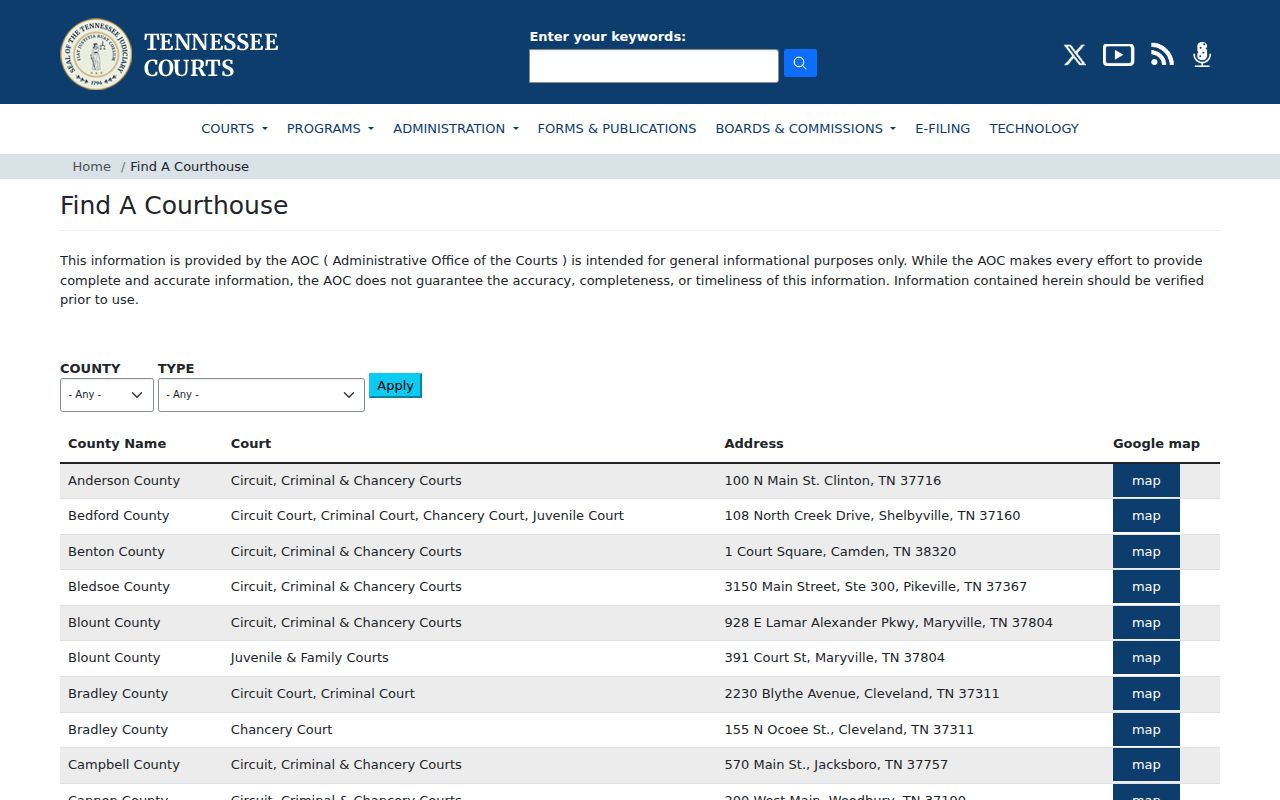
That locator helps you plan a court visit. It is not a statewide case search. No single portal speaks for every Tennessee court.
AOC also compiles statistics from clerk submissions. Aggregates tell you about statewide activity, not one person's docket. For copies, settings, or docket corrections, call the office holding the record.
The Trial Judge Case Statistics dashboard draws on those clerk reports and updates quarterly. It is a workload picture, not a public lookup for an individual matter.
Note: Use the courthouse finder to find courts. Use the clerk directory to find record contacts.
Tennessee Statewide Case Search Portal
Tennessee Public Case History, branded "Appellate Case Search," is the state's free statewide portal. It covers the Supreme Court, Court of Appeals, and Court of Criminal Appeals. No account is needed. There is no trial-county or court filter. A result can show the originating court, the trial judge and case number, parties, and counsel. You may also see appeal milestones, a dated Case History, and linked appellate records.
| Portal Feature | What It Covers | Coverage Limit |
|---|---|---|
| Tennessee appellate case index | Tennessee Supreme Court, Court of Appeals, and Court of Criminal Appeals | Appellate cases only, not county trial cases |
| Tennessee case-search fields | Case Number, Case Style, Party Name, Business/Organization | No county, trial-court, or date filter |
| Tennessee case detail | Appeal events and lower-court identifiers | Not a full local court docket or case file |
| Tennessee appellate records | Some linked appellate filings | Link availability does not establish that a trial paper is online |
| Tennessee public access | Free appellate case search without a required account | No statewide trial docket sign-in or feed |
The Tennessee Appellate Clerk resource page pulls together case search tools and other appellate services.
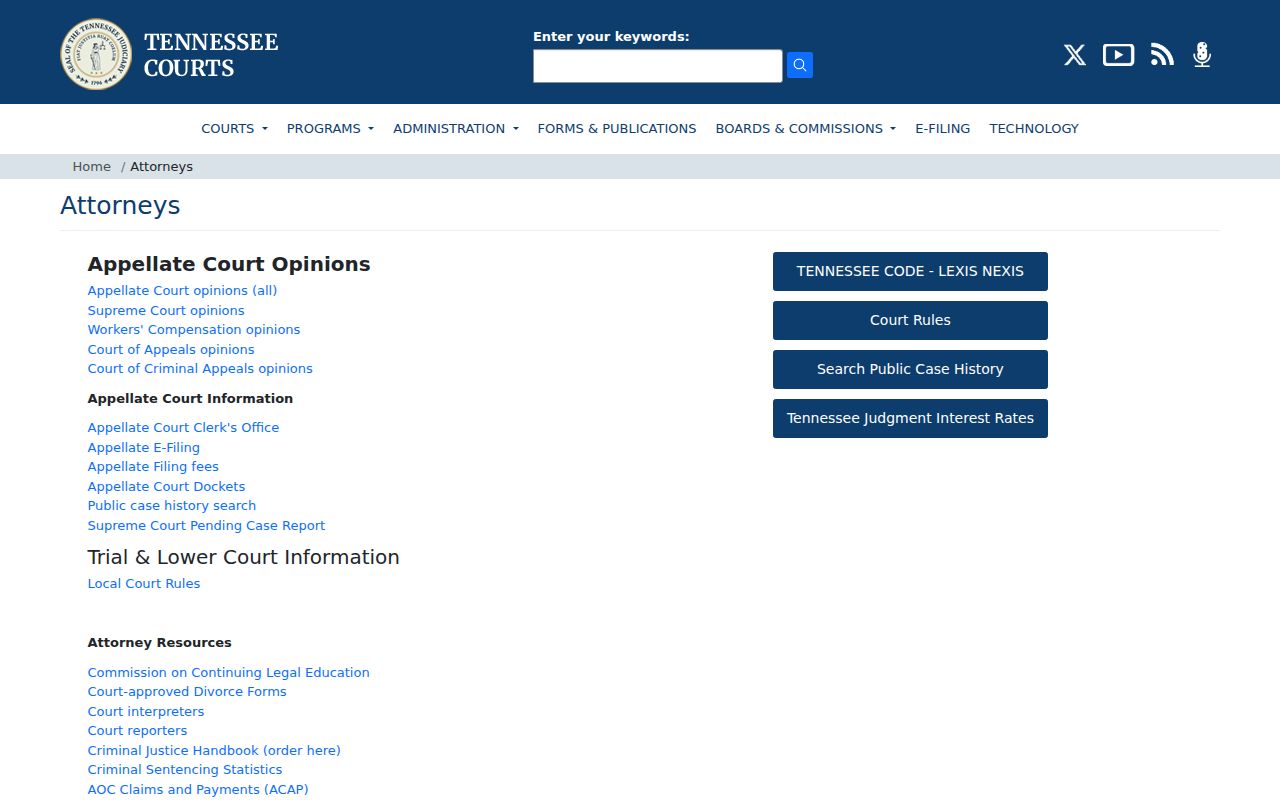
These links stay in the appellate world. A PCH motion or order entry will not hand you the trial paper. It will not yield an exhibit or the local court docket either.
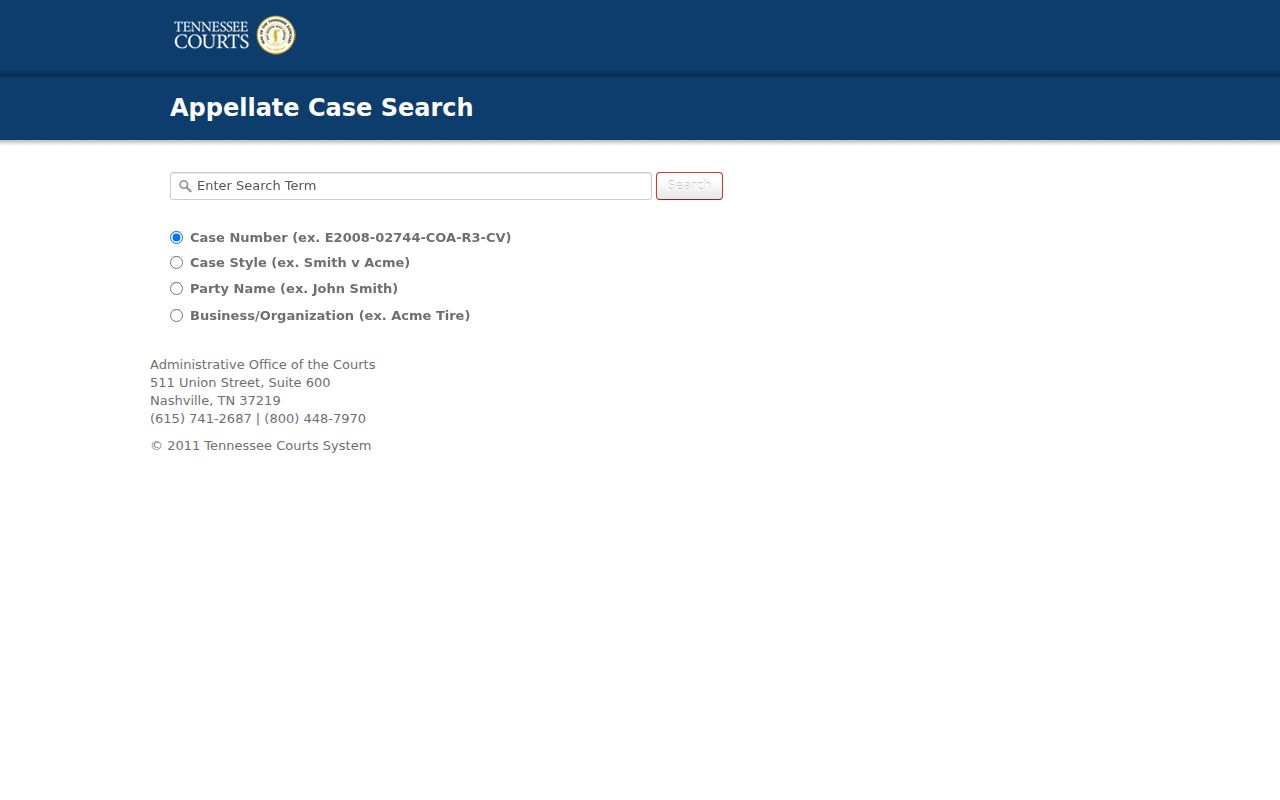
The search form wants text in one of four fields: Case Number, Case Style, Party Name, or Business/Organization. There is no county, trial court, or date filter. Appellate case history covers records filed after September 1, 2006. Linked filings begin after August 26, 2013. Neither date reaches trial records.
The blank Tennessee Public Case History search form lays out the four appellate criteria. It does so without opening any case.
Appeals are all it searches. Unappealed trial matters never appear. To follow a result back to the local clerk, see the Case Search guide.
Public Case History Covers Tennessee Appellate Cases
An appeal opens its own case record. The trial clerk keeps the Tennessee docket and file. The Appellate Clerk keeps the appeal. PCH may list the originating court and trial number, but the appeal carries its own number and its own event history.
Rule 20B, effective July 1, 2026, governs public electronic access and redaction for appellate filings, and Rule 46 governs appellate e-filing. Neither turns PCH into a county trial search. AOC's opinion search publishes opinions rather than a full procedural docket.
Need a trial reset confirmed or a signed lower-court record? Ask the originating clerk. Give that office the trial case number, plus the appellate reference if it helps.
Tennessee Dockets from County to State
A Tennessee trial filing enters that court's docket register first. A vendor submitting data proves nothing about a public case index or record images online. When a party appeals, the notice lands in the trial file and the appellate clerk opens a separate case, which PCH tracks. Tennessee trial calendars are never copied into PCH.
Case path: County or city filing › Local court register › Notice of appeal in the trial file › Separate appellate case number › PCH appellate history
Match a PCH result to a real office with the Tennessee AOC county clerk directory. A trial hearing, case paper, or certified court judgment comes from that local court, appeal or no appeal.
Note: An appellate number and a local trial number identify related but separate Tennessee case files.
32 Tennessee Judicial Districts Across 95 Counties
Tennessee spreads its courts across 95 counties and 32 judicial districts. Three appellate courts sit above them. Every county has a General Sessions court. Criminal, Chancery, Probate, Juvenile, and Municipal courts come and go by local assignment. So the trial docket you need may sit with any of them.
One clerk often handles both General Sessions and Circuit filings in a Tennessee county. Other divisions get their own clerks. Probate work may stand alone or ride with Chancery or Circuit. Read the court named on your case papers, then confirm the right office locally.
District lines do not merge dockets. The Tennessee courthouse finder and clerk directory can steer a request. But neither one searches cases or lists full record coverage.
Tennessee E-Filing and Rule 46
Tennessee runs appellate and trial e-filing on separate tracks. Rule 46 sets the appellate rules. Trial filing and docket access vary by court, vendor, and local rules. The tools have included Odyssey eFileTN, Tybera eFlex, Tyler products, homegrown tools, and plain paper. A filing vendor is not the same thing as a public case search. The official Rule 46 electronic-filing page lays out the appellate framework.
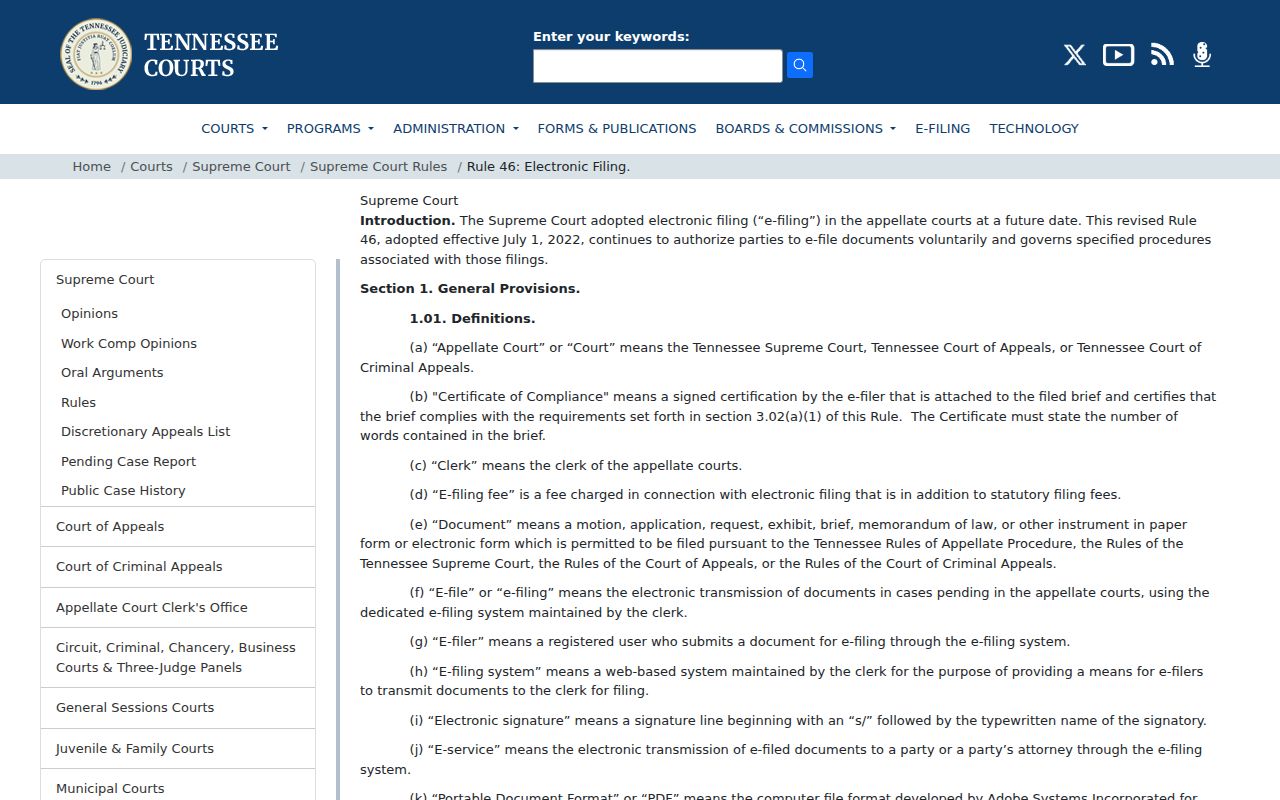
Rule 46 will not hand you a public Tennessee trial docket portal. For court filings, check the clerk's own page. A filing receipt proves an authorized submission went through. It does not prove the public can view the record or pull an image.
Tennessee has no single live statewide public trial e-filing system or mandate. Ask the clerk directly whether your case type goes through e-filing. Ask where its public register shows up.
The AOC assessment put e-filing at about 40 of more than 300 Tennessee courts. Most of it ran through Tybera eFlex. That count is dated, and it is not today's statewide trial-case coverage figure.
Tennessee Court CMS Award Is Not Public
Public Chapter 947, now Tenn. Code Ann. §16-3-822, drives AOC's court-system work in Tennessee. A February 2, 2026 report notes a Notice of Award issued December 16, 2025. An award alone settles nothing. It establishes no public search URL, county docket coverage, migration date, or vendor.
A September 2, 2026 status report appears on the listing. Treat its existence as just that. Deployment facts cannot be inferred from a title. A planned repository is not public access. AOC has to publish a live service with coverage details first.
For now, use PCH for Tennessee appeals and local clerks for trial cases. When a launch notice comes, check it closely. The notice should spell out the courts, case types, docket years, records, and correction route it covers.
Note: A procurement award does not tell a reader which trial cases are searchable today.
Tennessee Statewide Portal vs County Docket
PCH searches three Tennessee appellate courts; each county's trial docket stays with its local clerk. County portals differ widely, and no complete statewide participation list exists for Tennessee courts. The county directory is the place to start for local case records.
| Feature | Statewide PCH | County / Local Docket |
|---|---|---|
| Tennessee record coverage | Three appellate courts | Local courts, divisions, case types, and docket years as offered |
| Tennessee case identifier | Separate appellate case number and style | Trial case number assigned locally; no universal format |
| Tennessee case history | Appellate Case History and appeal milestones | Trial filings, settings, and local court docket entries when published |
| Tennessee court documents | Some linked appellate filings within coverage | May be online, limited to an index, or available from the clerk |
| Tennessee certified trial copy | Not custodian of the originating county's trial file | Request from the Tennessee clerk holding the case record |
| Tennessee docket update | No public real-time interval verified | Refresh practices vary; confirm a dated case event with the clerk |
When both levels matter, keep both case numbers handy. Name the document or event you need, since neither index substitutes for the full record.
Tennessee TJIS Is Not Case Search
The Tennessee Judicial Information System (TJIS) manuals standardize court statistics. They run from filing categories to case dispositions. A statewide total tells you nothing about party search, a hearing calendar, or a docket entry. It does not make filing images public either.
The layers sit apart. A vendor may take Tennessee case filings, and a local CMS may keep the docket register. AOC may collect the statistics. Nothing requires them to share search fields or update times. TJIS is not an individual case-record lookup.
Go to the Tennessee clerk for a case record. Go to AOC reports for statewide counts. Statistics cannot confirm that a particular court case exists or what happened in it.
Tennessee Court Technology and History
Tennessee appellate case tracking went online in 2013 with PCH and C-Track. AOC still maintains that portal. Trial courts kept their local systems, vendors, and paper, so Tennessee trial-docket searches stay court-specific.
Public Chapter 947 set a statewide systems mandate in 2024. AOC procured trial CMS and e-filing in 2025. Its February 2026 report described a target architecture rather than a live case-search service.
Treat a planned system as public access only after an official launch and coverage notice. The September 2, 2026 report listing supports no claim about a vendor, pilot, or go-live.
AOC reported in 2017 that TnCIS ran in 86 Tennessee counties. That is a historical adoption figure. It is not a current map of local court-record, CMS, or e-filing access.
Note: the 2017 TnCIS county count is dated. Do not read it as a current rollout or public-search map.
Route Tennessee Court Records Locally
A Tennessee trial docket stays with its court or city clerk. Begin with the court named on the case paper. Then use Counties to confirm the office. Circuit, Criminal, Chancery, General Sessions, Juvenile, Probate, and Municipal cases can each sit with a different custodian.
For a Tennessee appeal, jot down the appellate case number, style, originating court, judge, and trial number. Then request the trial file from that court's clerk. PCH is not a feed of local docket events.
Confirm dates with the coordinator or clerk. Order copies from the clerk. Ask the court reporter for transcripts or audio. Those are three separate record routes.